Noise Control: A Beginner's Guide to Understanding Decibels at Home
Most of us judge noise by feel: the fridge that turns sinister at midnight, the odd silence of a kitchen when the boiler finally stops. Decibels put a number on that feeling, and the numbers rarely behave the way we expect. A room reading 45 dB is not "a bit louder" than one at 35 dB — it carries ten times the sound energy. Knowing a few basics makes it far easier to work out what is worth fixing, what you can live with, and when it is worth saying something to a neighbour.
What a decibel actually measures
Sound is a pressure wave travelling through air, and the decibel scale compresses an enormous range of pressures into two-digit numbers. Zero decibels is not silence; it is roughly the quietest sound a healthy young ear can detect. Every 10 dB step represents a tenfold increase in sound energy, and a rise of just 3 dB doubles it.
Your hearing does its own compressing, which is why the scale feels manageable. A 10 dB increase generally registers as about twice as loud, so the jump from a whisper to a normal conversation feels like a big step rather than the thousandfold energy increase it actually is.
Two weightings are worth knowing if you ever measure anything. dB(A) is tuned to how human hearing responds, which means dull low rumbles count for less. dB(C) keeps the bass in. If a neighbour's music is the problem and your phone app reads a modest number, it may be under-reporting exactly the frequencies that are bothering you.
A rough map of noise in a typical home
All of these are approximate. Distance, soft furnishings and building materials shift the reading considerably, so treat the figures as landmarks rather than rules.
- 20–30 dB: an empty room at night, a quiet garden well away from roads. This is the range bedrooms should sit in.
- 30–40 dB: a fridge hum, a whisper across a room, distant traffic heard through closed double glazing.
- 40–50 dB: quiet conversation, a dishwasher running in the next room, a laptop fan under load.
- 50–60 dB: normal conversation, a washing machine on spin, a busy road from indoors with the windows shut.
- 60–70 dB: a vacuum cleaner, a kettle coming to the boil nearby, a television at a comfortable volume.
- 70–85 dB: a blender, loud music, a doorbell at close range.
- Above 85 dB: a drill or other power tools. Prolonged exposure at this level is where hearing damage becomes a genuine concern, so keep sessions short and use protection.
Phone sound apps are indicative at best, since microphones vary and most are not calibrated. Use them to compare one moment with another, not to settle an argument.
Why the quiet numbers cause the most trouble
Concentration rarely collapses because something is loud. It collapses because something is interesting. Human speech is the worst offender: even at 45–50 dB, a conversation you can half-hear through a wall pulls at your attention more than a vacuum cleaner at the same volume. That is why a television left on in another room can wreck an hour of work, while steady rain against the window barely registers.
If you work from home, the useful question is not "how loud is it?" but "is there speech in it?" Moving a desk away from a shared wall often does more for focus than any amount of acoustic panelling.
Sleep, rest and the 30 dB question
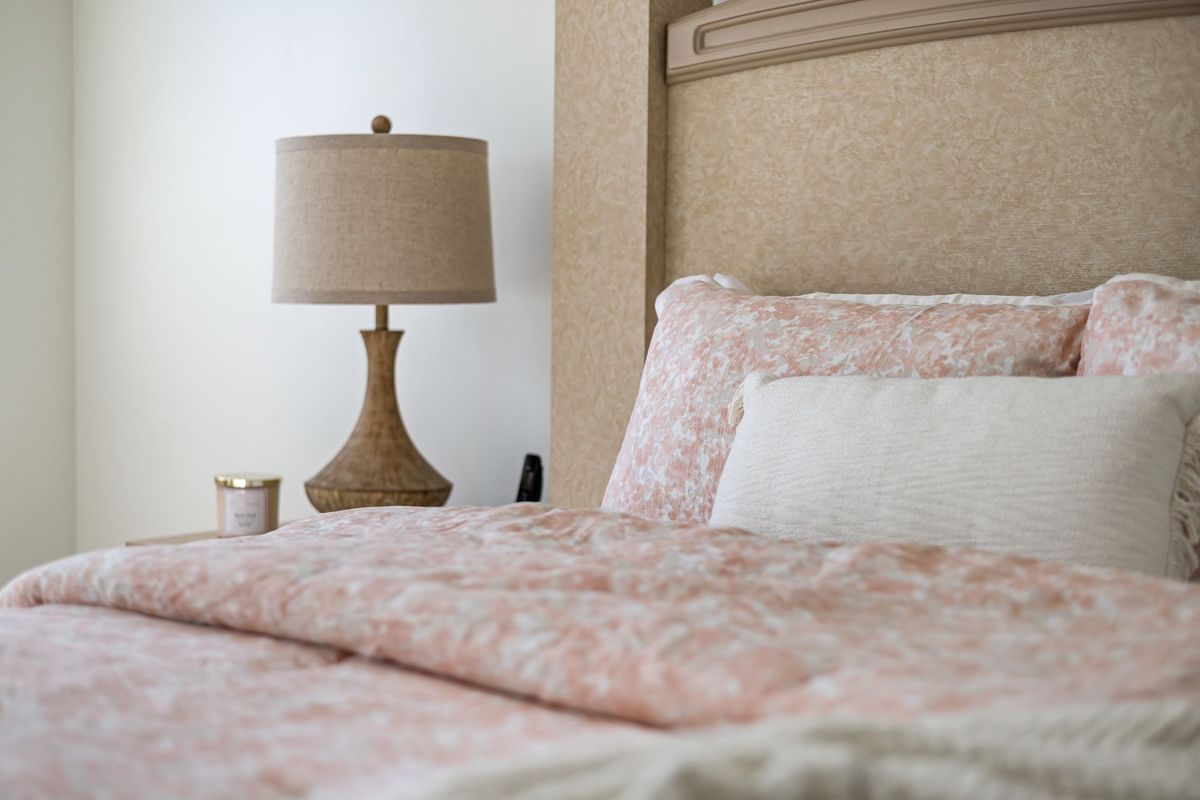
Bedrooms are where small numbers matter most. Sleep guidance generally points towards keeping night-time noise in a bedroom down near 30 dB, which in practice means a quiet room with the fridge humming somewhere else in the flat. Sounds that do not fully wake you can still pull you out of deep sleep, which is why a neighbour's early-morning routine can leave you flat all day even when you feel you slept through it. If you are persistently waking or struggling to sleep, speak to your GP rather than trying to solve it with earplugs alone.
When noise is coming through the wall
Airborne noise — voices, televisions, music — and impact noise — footsteps, doors, dropped objects — behave quite differently, and they are fixed by different measures. Bass is the awkward one. Low frequencies travel through structure rather than air, which is why a neighbour's music can arrive as a formless thud that no cushion or curtain will touch.
If a friendly conversation does not resolve things, most UK councils have an environmental health team that can advise on noise nuisance. Procedures and thresholds vary between areas, so check your own council's guidance before pursuing that route, and keep a dated record of what you hear and when if you do.
Five things to try before you spend anything
- Find the real source. Stand in your own room and listen with the door shut, then open. You may find the problem is a doorway gap, a shared chimney breast or an unsealed floorboard rather than the wall itself.
- Break the path. Seal gaps around doors and letterboxes, fit a brush strip, or simply roll a towel along the bottom of a door while you work. Small openings let through a surprising amount of sound.
- Decouple what vibrates. Move speakers off the shared wall and onto a shelf or stand. Fit anti-vibration feet under a washing machine. Put felt pads under chair legs in a flat.
- Move the room's job. Shift a desk, bed or headboard away from the wall you share with a neighbour. A metre of distance and a soft surface between you both helps more than you would think.
- Mask rather than fight. A fan, a quiet air purifier or a steady low-level background sound covers the sharper, more distracting noises. The point is not to drown anything out but to give your ears something uninteresting to settle on.
Start small, and start with listening
Before buying anything, spend a day noticing. Note when the noise peaks, which room it reaches, and whether it is speech, thumps or a low drone. That single page of notes will tell you whether you need a door seal, a rug, a repositioned sofa or a conversation over the fence.
Quiet at home is rarely achieved in one grand gesture. It comes from a handful of small, sensible fixes, made in the right order, once you understand that a few decibels either way can mean a great deal.
Photo: Anna Pou / Pexels